
GDP-En-Product-Logo-header-V1
Back to the product list

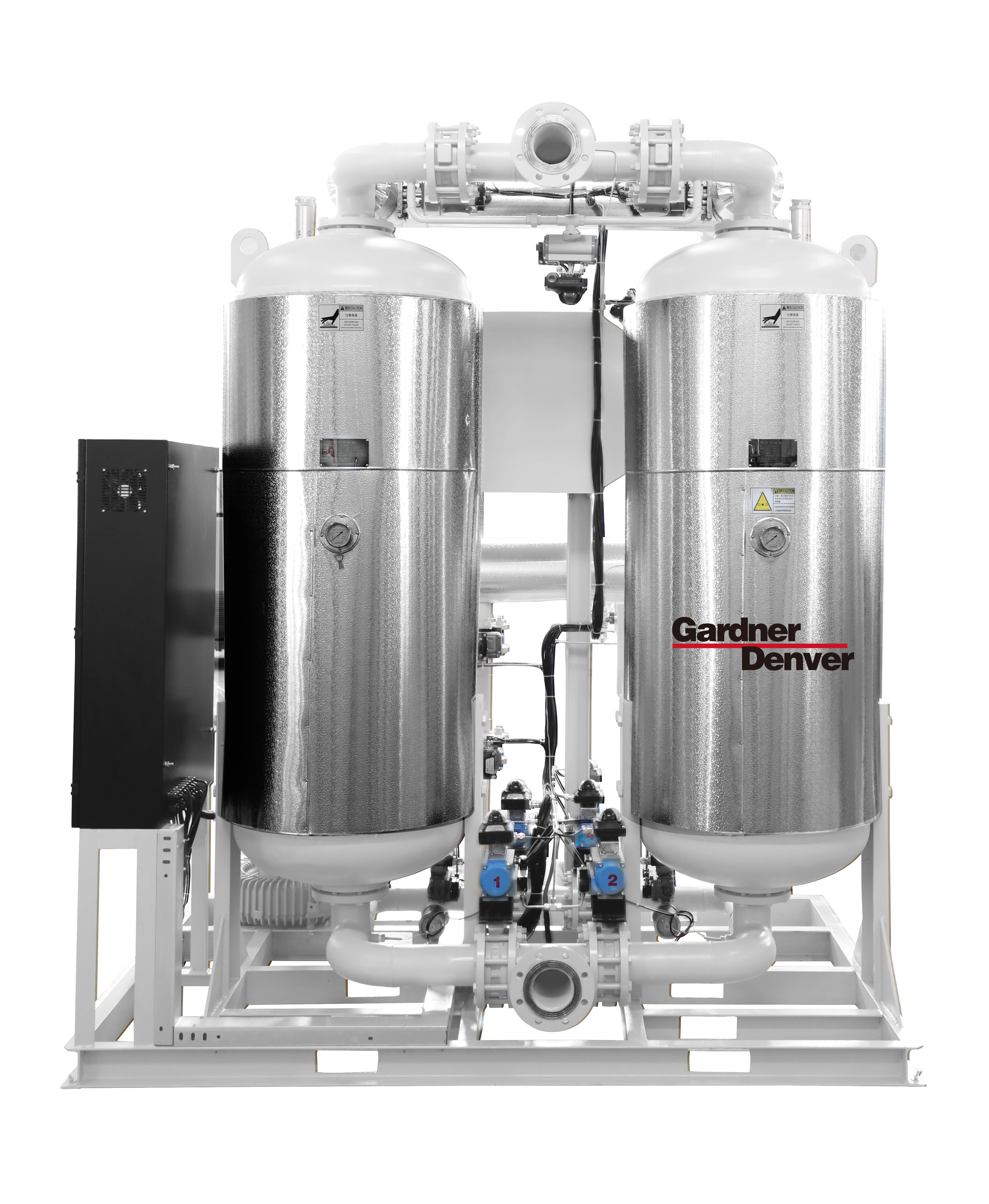
GD-IBRi Heat Regeneration Adsorption Dryer

Gardner Denver blast heat regeneration adsorption dryer adopts the principle of blast heating to complete the high-efficiency compressed air drying work. Greatly save the loss of compressed air and save energy.

The blower extracts ambient air, and after heating by an external electric heater, the hot air enters the regeneration tower for heating and regeneration of the adsorbent.

After a period of thermal regeneration, turn off the heater, use a blower to cold blow regeneration and cool down;

When the temperature of the adsorption tower is reduced to a certain point, the dry gas at the outlet of the working tower is used to regenerate the regeneration tower by cold blowing, and the average gas consumption in the cycle is ≤3%, so as to finally complete the regeneration of the adsorbent in the regeneration tower.

When the outlet air quality requirements are not high (such as atmospheric dew point ≤-40°C) or when the ambient temperature is low, only the blower can be used for cold blowing regeneration without introducing dry gas at the outlet of the working tower, so there is no regeneration gas consumption (at this time, the regeneration gas consumption is zero).

Adopt double eccentric PTFE sealed butterfly valve, reliable performance and long life.

The high-quality two-position five-way solenoid valve is used to pneumatically actuate the valve to ensure the reliable operation of the equipment. Reliable performance blowers are used to ensure the normal operation of the dryer system.

The unique design ensures that the drying and regeneration airflow is evenly distributed, and eliminates the phenomenon of "short circuit" with large center flow velocity and small edge flow velocity. The tower body and high-temperature pipelines are insulated, and embossed aluminum plates are outsourced to eliminate energy waste.

The specific pressure filling function ensures uninterrupted air supply when the dryer is switched.

A variety of measures are used to ensure that the layer bed is not loose, the desiccant is not worn, and the desiccant is prolonged.

The slower airflow through the dryer increases the contact time with the desiccant, ensures the dew point, and reduces pressure loss. Each tower has a pressure gauge and a safety valve.

Proper cooling periods are included in the regeneration cycle to prevent dew point peaks during the changeover. Standard configuration: PLC programmable controller, human-computer interface.